


Strain Checker
Strain Checker FGMH Series
(Frictional strain gauge)
Conventional strain gauges pick up strain on the structures through adhesive layers. On the contrary, the strain checker picks up strain through friction by pressing down the strain sensing element on the structure with the magnet. The strain checker can be easily fixed on the position of interest and immediately get ready for strain measurement. The FGMH-1B/FGMH-4A is a standard type with small and light construction. The FGMH-2B is for measurement in a narrow space, such as a side of a welded part. The FGMH-3B has 3-element 45° / 90° rectangular rosette configuration capable of measuring strains in 3 axes and obtaining principal stress (principal strain) by rosette analyses.
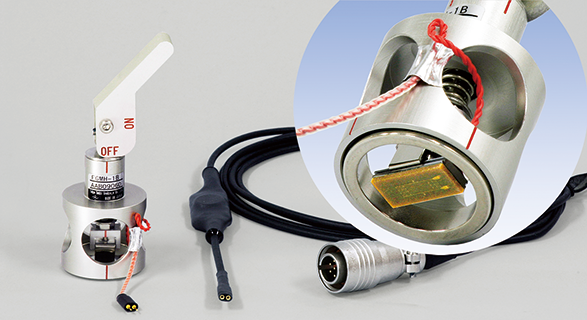

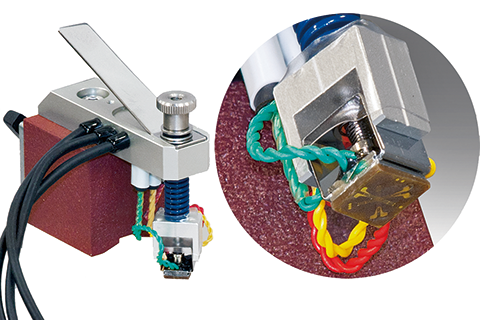

- Features
- Adopting friction
Adheres to the object with magnet and picks up strain by means of friction generated on the contact surface. - No need of adhesive
Installation procedures of conventional strain gauges such as removing paint, grinding, degreasing, bonding and curing are not required. Measurement is available immediately after attaching the strain checker. - No need of paint restoration after measurement
It is not necessary to restore the paint after the measurement, because the measurement is made without removing the paint. - Enables to use repeatedly
Measurement point can be easily moved because the strain checker is easily attached and detached. It is possible to find the most strained point by moving the strain checker like as a stethoscope, using a DH-14A as a strain reading instrument. - Multiple simultaneous measurement
Simultaneous measurement of multiple points is possible by using two or more strain checkers. Strain distribution and principal stress direction can be obtained.
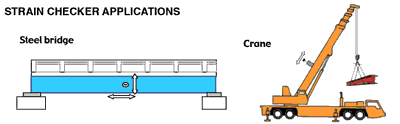
- Adopting friction
-
Specifications
Type FGMH-1B FGMH-2B FGMH-3B FGMH-4A Number of axes Single(1) 3 Single Gauge length 6mm 3mm 3mm or 6mm Allowable temperature range 0 to +60℃ Gauge factor Approx. 2 Input/output resistance Approx.120Ω Measurement mode Full bridge Supplied cable - Φ3mm 0.05mm2
4-core shielded chloroprene cable 2m with NDIS-plug3- Φ3mm 0.05mm2
4-core shielded chloroprene cable with a connector plug- Supplied cable 2m with bridge circuit board with NDIS plug - Φ3mm 0.05mm2
4-core shielded chloroprene cable 2m with NDIS-plug
(Type : FGL-2B)Weight Approx. 60g (excluding cable) Approx. 260g (excluding cable) Approx. 30g